
In today’s dynamic and interconnected world, investors face a myriad of challenges. Geopolitical tensions, economic downturns, technological disruptions, and climate change can all significantly impact investment portfolios. Traditional investment strategies that rely on historical data and linear projections may fall short in navigating these complexities. This is where scenario planning emerges as a crucial tool for building portfolio resilience.
What is Scenario Planning?
Scenario planning is a structured process for envisioning multiple plausible futures and developing strategies to thrive in each. It involves identifying key uncertainties, developing narratives around how these uncertainties might unfold, and assessing the potential impact of each scenario on the investment portfolio. By considering a range of possibilities, investors can better prepare for unexpected events, mitigate risks, and capitalize on opportunities.
Why is Scenario Planning Important for Portfolio Resilience?
Scenario planning offers several key benefits for investors seeking to build resilient portfolios:
- Enhanced Risk Management: By considering a wider range of potential outcomes, investors can identify and mitigate risks that may not be apparent through traditional forecasting methods.
- Improved Decision-Making: Scenario planning provides a framework for evaluating investment decisions under different conditions, leading to more informed and robust choices.
- Increased Adaptability: By developing strategies for multiple scenarios, investors can adapt more quickly to changing circumstances and capitalize on emerging opportunities.
- Stronger Communication: Scenario planning facilitates communication among stakeholders by providing a shared understanding of potential risks and opportunities.
The Scenario Planning Process
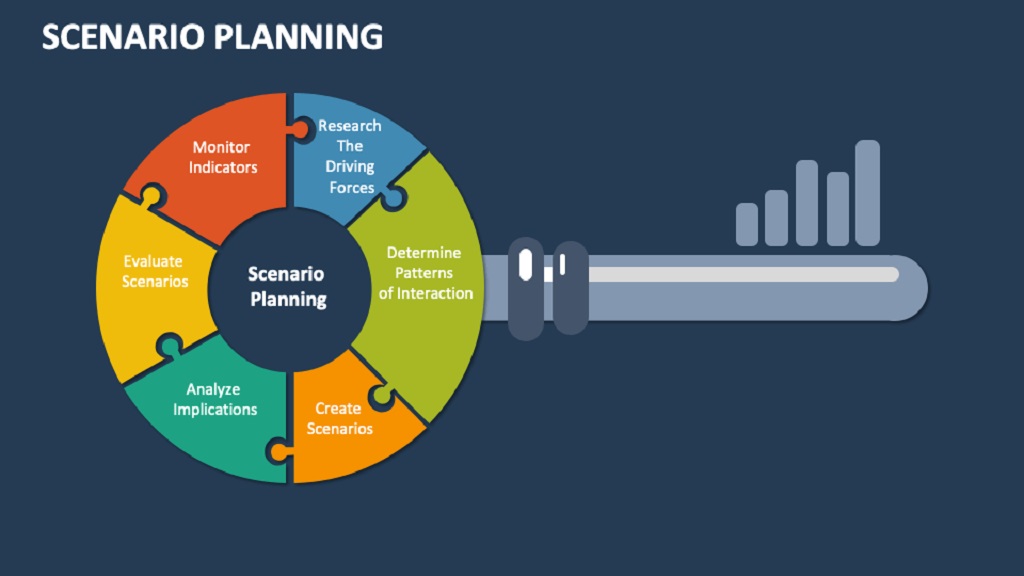
The scenario planning process typically involves the following steps:
- Define the Scope: Clearly define the investment portfolio, the time horizon for the analysis, and the key factors that may influence its performance.
- Identify Key Uncertainties: Identify the most critical uncertainties that could significantly impact the portfolio. These uncertainties may be economic, geopolitical, technological, or environmental in nature.
- Develop Scenario Narratives: Develop a set of plausible scenarios based on different combinations of the key uncertainties. Each scenario should be internally consistent and tell a compelling story about the future.
- Assess Portfolio Impact: Analyze the potential impact of each scenario on the investment portfolio, considering factors such as asset allocation, risk exposure, and return expectations.
- Develop Strategic Responses: Develop strategies for each scenario, including adjustments to asset allocation, risk management measures, and tactical investment decisions.
- Monitor and Adapt: Continuously monitor the environment for changes in the key uncertainties and adapt the portfolio strategy accordingly.
Scenario Planning in Practice
Let’s consider a hypothetical example of an investor with a diversified portfolio consisting of stocks, bonds, and real estate. Some key uncertainties that could impact this portfolio include:
- Economic Growth: Will the economy experience strong growth, moderate growth, or a recession?
- Inflation: Will inflation remain low, rise moderately, or surge to high levels?
- Interest Rates: Will interest rates stay low, rise gradually, or increase sharply?
- Geopolitical Stability: Will geopolitical tensions escalate, remain stable, or ease?
Based on these uncertainties, the investor could develop several scenarios, such as:
- Scenario 1: “Strong Growth, Low Inflation”: This scenario assumes robust economic growth, low inflation, and gradual increases in interest rates. In this environment, stocks may perform well, while bonds may experience moderate returns.
- Scenario 2: “Stagflation”: This scenario assumes slow economic growth, high inflation, and rising interest rates. In this environment, both stocks and bonds may struggle, while real estate may offer some protection.
- Scenario 3: “Geopolitical Crisis”: This scenario assumes heightened geopolitical tensions, leading to market volatility and economic uncertainty. In this environment, safe-haven assets such as gold and government bonds may perform well, while stocks and real estate may decline.
By analyzing the potential impact of each scenario on the portfolio, the investor can develop strategies to mitigate risks and capitalize on opportunities. For example, in the “Stagflation” scenario, the investor may consider increasing exposure to inflation-hedging assets such as commodities or real estate. In the “Geopolitical Crisis” scenario, the investor may reduce equity exposure and increase holdings of safe-haven assets.
Integrating Scenario Planning with Other Investment Strategies
Scenario planning can be effectively integrated with other investment strategies, such as:
- Diversification: Scenario planning can help investors identify potential risks and opportunities across different asset classes and geographies, leading to a more diversified and resilient portfolio.
- Value Investing: Scenario planning can help value investors assess the long-term prospects of companies under different scenarios, ensuring that their investments are resilient to changing conditions.
- Growth Investing: Scenario planning can help growth investors identify emerging trends and technologies that may thrive in different future scenarios.
Reviews of Scenario Planning
Scenario planning has garnered positive reviews from investors and financial professionals alike. Here are some testimonials:
- “Scenario planning has helped us to make more informed investment decisions and build a more resilient portfolio. By considering a range of potential outcomes, we are better prepared for unexpected events and can adapt more quickly to changing circumstances.” – John Smith, Portfolio Manager
- “Scenario planning is an invaluable tool for navigating uncertainty. It allows us to challenge our assumptions, identify potential risks, and develop strategies for success in a variety of future environments.” – Jane Doe, Chief Investment Officer
Frequently Asked Questions (FAQ)
Q: How often should I conduct scenario planning?
A: The frequency of scenario planning depends on the specific investment portfolio and the level of uncertainty in the environment. However, it is generally recommended to conduct scenario planning at least annually, or more frequently if there are significant changes in the investment landscape.
Q: What are some common challenges in implementing scenario planning?
A: Some common challenges include:
- Identifying the right uncertainties: It can be challenging to identify the most critical uncertainties that could impact the portfolio.
- Developing plausible scenarios: It is important to ensure that the scenarios are internally consistent and tell a compelling story about the future.
- Overcoming biases: It is important to be aware of cognitive biases that can influence the scenario planning process.
- Communicating effectively: It is essential to communicate the results of the scenario planning process effectively to stakeholders.
Q: What are some resources available to help me with scenario planning?
A: There are several resources available to help investors with scenario planning, including:
- Books and articles: There are numerous books and articles available on scenario planning, offering guidance on the process and practical examples.
- Software tools: Several software tools can help investors with scenario planning, providing templates and analytical capabilities.
- Consultants: There are consultants who specialize in scenario planning and can provide customized support to investors.
Conclusion
Scenario planning is a powerful tool for building portfolio resilience in the face of uncertainty. By considering a range of potential outcomes, investors can better prepare for unexpected events, mitigate risks, and capitalize on opportunities. My Stocks Portfolio & Market Apps: A Deep Dive into the Best Investment Tools explores how integrating scenario planning with other investment strategies helps investors build robust portfolios that thrive in various future environments.
Additional Tips for Effective Scenario Planning
- Involve a diverse team: Include individuals with different perspectives and expertise in the scenario planning process.
- Challenge assumptions: Encourage participants to challenge their assumptions and consider alternative viewpoints.
- Use quantitative and qualitative data: Combine quantitative data with qualitative insights to develop a comprehensive understanding of potential future scenarios.
- Don’t be afraid to be creative: Encourage participants to think outside the box and develop innovative strategies for navigating uncertainty.
- Regularly review and update scenarios: The world is constantly changing, so it is important to regularly review and update scenarios to ensure they remain relevant.
By following these tips, investors can enhance the effectiveness of their scenario planning efforts and build more resilient portfolios.
Incorporating scenario planning into your investment strategy can be a game-changer, enabling you to navigate uncertainty with confidence and achieve your financial goals.