
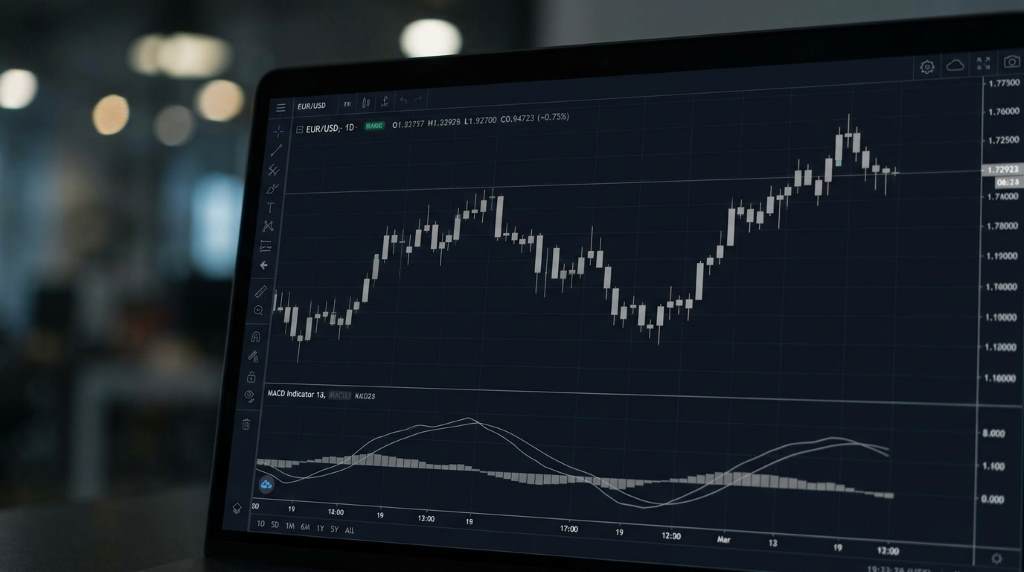
Finding the right trade entry often separates consistent traders from those who struggle with timing. Learning how to set MACD signals for entries helps traders identify stronger opportunities while reducing emotional decisions. According to several market studies, technical indicators influence more than 70% of retail trading decisions. Meanwhile, disciplined trading plans improve long term consistency because traders follow objective rules instead of reacting to market noise.
Understand the MACD Indicator Before Setting Entry Signals
The Moving Average Convergence Divergence indicator measures momentum and trend direction through moving averages. It helps traders recognize potential trend changes before major price movements develop. Many investors also strengthen their market knowledge by exploring topics like purchase fractional international airline stocks because broader market understanding improves trading decisions.
The MACD includes three important components that work together. Each component provides different information about market momentum and possible entry opportunities.
- MACD Line
- Signal Line
- Histogram
The MACD line represents the difference between two exponential moving averages. The signal line smooths MACD movements, while the histogram shows momentum strength between both lines.

Why MACD Remains Popular
Many traders prefer MACD because it combines trend following with momentum analysis. Therefore, it reduces the need for several overlapping indicators.
Choose the Right MACD Settings for Your Trading Style
The default MACD setting uses 12, 26, and 9 periods because it balances responsiveness with reliability. However, different trading styles require different settings to match market conditions.
Short term traders often prefer faster settings because they generate earlier signals. Likewise, swing traders usually stay with standard settings because they reduce false entries.
| Trading Style | Suggested MACD Settings |
|---|---|
| Scalping | 5, 13, 6 |
| Day Trading | 8, 21, 5 |
| Swing Trading | 12, 26, 9 |
| Position Trading | 19, 39, 9 |
Testing different settings on historical charts builds confidence before risking real money. Similarly, reading practical investing examples like investor used partial shares shows how disciplined strategies often outperform emotional decisions.
Avoid Constantly Changing Settings
Changing MACD values after every losing trade creates inconsistency. Instead, test one configuration across many market conditions before making adjustments.
Identify High Quality MACD Entry Signals
Not every MACD crossover deserves a trade because weak signals appear during sideways markets. Therefore, traders should combine several confirmation factors before entering positions.
The strongest entry often appears when multiple technical signals align together. This approach increases probability while reducing unnecessary trades.
Bullish Signal Line Crossover
A bullish crossover happens when the MACD line moves above the signal line. Consequently, buyers may begin gaining momentum after previous weakness.
Bearish Signal Line Crossover
A bearish crossover occurs when the MACD line falls below the signal line. Therefore, sellers may start controlling price movement.
Zero Line Confirmation
Crossovers above the zero line generally support stronger bullish trends. Likewise, crossovers below the zero line usually confirm stronger bearish momentum.
Histogram Expansion
Growing histogram bars indicate increasing momentum behind price movement. As a result, entry signals become more reliable when momentum strengthens.
Combine MACD with Other Technical Indicators
MACD performs better when traders avoid using it alone. Instead, combining complementary indicators creates stronger confirmation before opening positions.
Several technical tools work especially well with MACD because each measures different market characteristics. Consequently, traders gain a more complete market picture.
- Relative Strength Index
- Support and resistance zones
- Volume analysis
- Trend lines
- 50 period and 200 period moving averages
MACD Plus RSI
A bullish MACD crossover becomes stronger when RSI rises above 50. Likewise, bearish setups improve when RSI falls below 50.
MACD with Support and Resistance
Entry signals near major support often offer better risk to reward opportunities. Similarly, bearish entries near resistance improve trade quality.
Create Clear Entry Rules Before Every Trade
Successful traders follow written rules instead of relying on emotions. Therefore, every trade should satisfy predefined conditions before execution.
A simple checklist removes uncertainty while improving consistency over hundreds of trades. Moreover, disciplined routines simplify decision making during volatile sessions.
- Trend matches trade direction.
- MACD crossover confirms momentum.
- Histogram supports the signal.
- Price respects key support or resistance.
- Risk to reward ratio remains favorable.
Wait for Candle Confirmation
Many false signals disappear before a candle closes. Consequently, waiting for candle confirmation reduces unnecessary losses.
Manage Risk After Entering a Trade
Even the best MACD setup cannot guarantee success because markets remain unpredictable. Therefore, risk management protects trading capital over time.
Professional traders focus more on protecting money than chasing profits. As a result, they survive losing streaks without damaging their accounts.
Set Logical Stop Loss Levels
Place stop losses beyond recent swing highs or swing lows instead of random distances. This approach reflects actual market structure.
Use Proper Position Sizing
Risking only a small percentage of trading capital keeps losses manageable. Consequently, traders remain emotionally stable during normal market fluctuations.
Take Profits Strategically
Partial profit taking locks in gains while allowing remaining positions to follow strong trends. Therefore, traders balance consistency with growth potential.
Common Mistakes When Using MACD for Entries
Many beginners misuse MACD because they expect every crossover to generate profits. Instead, successful traders understand that market context matters equally.
- Trading during sideways markets
- Ignoring higher timeframe trends
- Skipping stop losses
- Entering before candle confirmation
- Using excessive leverage
- Changing indicator settings too frequently
Avoiding these mistakes improves overall trading discipline while increasing long term performance. Furthermore, consistent habits produce better results than searching for perfect indicators.
Build a Repeatable MACD Trading Routine
Strong trading routines create consistency because every decision follows the same structured process. Therefore, traders spend less time reacting emotionally.
Review charts after every trading session and document successful entries alongside unsuccessful ones. Eventually, this journal reveals patterns that improve future performance.
Conclusion
Learning how to set MACD signals for entries requires more than memorizing crossovers because successful trading depends on confirmation, discipline, and risk management. Combine MACD with trend analysis, support levels, and proper position sizing for stronger results. Practice every strategy using historical charts before trading live capital. Start building a consistent trading plan today and refine your process through continuous review and disciplined execution.
Frequently Asked Questions
What is the best MACD setting for beginners?
The standard 12, 26, and 9 setting offers balanced signals for most beginners.
Should I trade every MACD crossover?
No, only trade crossovers that align with trend, momentum, and support or resistance confirmation.
Can MACD work without other indicators?
Yes, but combining MACD with other indicators generally improves signal reliability.
Which timeframe works best with MACD?
MACD performs well across multiple timeframes when matched with your trading style.
Does MACD predict market direction?
No, MACD measures momentum and trend strength instead of predicting future prices.