

Investors and analysts use the price-to-earnings ratio, or P/E ratio, as a fundamental metric to evaluate the relative value of a company’s stock. It essentially tells you how much investors are willing to pay for each dollar of a company’s earnings. Understanding the P/E ratio can be a powerful tool in your investment arsenal, allowing you to make informed decisions about buying or selling stocks. In this comprehensive guide, we’ll delve deep into the intricacies of the P/E ratio, exploring its calculation, interpretation, limitations, and frequently asked questions.
What is a P/E Ratio?
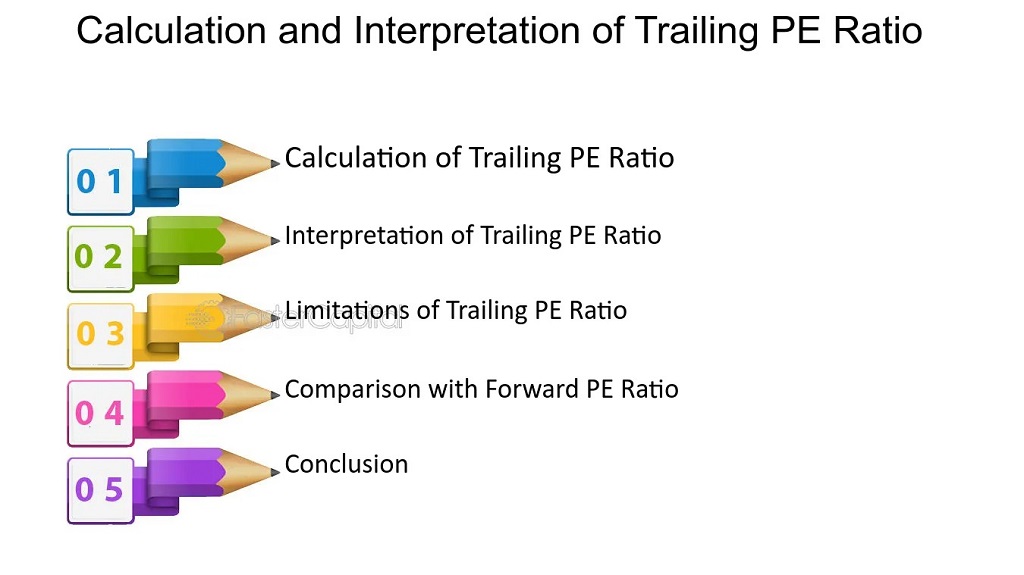
Someone calculates the P/E ratio by dividing the current market price of a company’s stock by its earnings per share (EPS). The EPS represents the portion of a company’s profit allocated to each outstanding share of common stock.
Formula:
P/E Ratio = Current Market Price per Share / Earnings per Share (EPS)
For example, if a company’s stock is trading at $50 per share and its EPS is $5, its P/E ratio would be 10 ($50 / $5 = 10). This means that investors are willing to pay $10 for every $1 of the company’s earnings.
Interpreting the P/E Ratio
You can interpret the P/E ratio in several ways.
- Relative Value: A higher P/E ratio generally indicates that investors are willing to pay a premium for the company’s earnings, possibly due to factors such as strong growth prospects, competitive advantages, or a well-established brand. Conversely, a lower P/E ratio may suggest that the company is undervalued or that investors are less optimistic about its future.
- Growth Expectations: High-growth companies typically have higher P/E ratios than mature, slow-growth companies. This is because investors are anticipating higher future earnings and are willing to pay a premium for that potential.
- Industry Comparison: It’s important to compare a company’s P/E ratio to its industry peers to get a sense of its relative valuation. A P/E ratio that is significantly higher or lower than the industry average may warrant further investigation.
Interpreting P/E Ratios with Nuance:
While the P/E ratio can be a useful tool, it’s crucial to interpret it with caution and consider other factors such as the company’s financial health, industry dynamics, and overall market conditions. Here are some additional points to keep in mind:
- Negative Earnings: Companies with negative earnings will have a negative P/E ratio, which is not meaningful for comparison purposes.
- Cyclical Earnings: Companies with cyclical earnings may have fluctuating P/E ratios, making it challenging to interpret their value based on this metric alone.
- One-Time Events: Extraordinary events, such as acquisitions or divestitures, can impact a company’s earnings and distort its P/E ratio.
Types of P/E Ratios
There are two main types of P/E ratios:
- Trailing P/E Ratio: The market most commonly uses this type of P/E ratio, which analysts calculate using the company’s earnings over the past 12 months.
- Forward P/E Ratio: Analysts calculate this type of P/E ratio using the company’s projected earnings for the next 12 months. It can be helpful for assessing a company’s future growth potential but relies on earnings estimates, which may not always be accurate.
Limitations of the P/E Ratio
While the P/E ratio is a valuable tool, it has some limitations:
- Doesn’t Account for Debt: The P/E ratio doesn’t consider a company’s debt levels, which can significantly impact its financial health and future prospects.
- Susceptible to Manipulation: Companies can manipulate their earnings through accounting practices, which can distort their P/E ratio.
- Ignores Qualitative Factors: The P/E ratio doesn’t capture qualitative factors such as management quality, brand reputation, and competitive landscape, which can be crucial for assessing a company’s long-term success.
How to Use the P/E Ratio in Investment Decisions
The P/E ratio can be a valuable tool for making informed investment decisions, but it shouldn’t be the sole factor you consider. Here are some ways to use the P/E ratio effectively:
- Compare with Industry Peers: Compare a company’s P/E ratio to its industry peers to identify potential overvaluations or undervaluations.
- Track Historical Trends: Analyze a company’s historical P/E ratio trends to understand its valuation patterns and identify potential buying or selling opportunities.
- Consider Growth Prospects: Factor in a company’s growth prospects when evaluating its P/E ratio. High-growth companies may justify a higher P/E ratio.
- Use in Conjunction with Other Metrics: Combine the P/E ratio with other financial metrics, such as the price-to-book ratio (P/B) and return on equity (ROE), to get a more comprehensive view of a company’s value.
Reviews of the P/E Ratio
Investors and analysts widely use and respect the P/E ratio as a valuation metric. Here are some reviews of the P/E ratio from reputable sources:
- Investopedia: “Investors and analysts widely use the P/E ratio as one of the most important tools to determine stock valuation. Besides showing whether a company’s stock price is overvalued or undervalued, the P/E ratio can reveal how a stock’s valuation compares to its industry group or a benchmark like the S&P 500 Index.”
- Morningstar: “The price-earnings ratio (P/E) is perhaps the most familiar and frequently used valuation measure. Investors calculate it by dividing a company’s current share price by its trailing 12-month earnings per share.”
- The Motley Fool: “The price-to-earnings (P/E) ratio is a simple but powerful metric that can help you determine whether a stock is cheap or expensive relative to its earnings.”
Read More Also: Day Trading vs. Long-Term Investing: A Beginner’s Guide to Building Wealth
Frequently Asked Questions (FAQ) about the P/E Ratio
-
What is a good P/E ratio?
There is no single “good” P/E ratio. A good P/E ratio depends on various factors, such as the company’s industry, growth prospects, and financial health. Investors must compare a company’s P/E ratio to its peers and historical trends to determine whether they are reasonably valuing the company.
-
Is a high P/E ratio always bad?
Not necessarily. A high P/E ratio can indicate that investors are optimistic about a company’s future growth prospects. However, it’s essential to ensure that the high P/E ratio is justified by the company’s fundamentals and not driven by speculation or hype.
-
Can a company have a negative P/E ratio?
Yes, a company can have a negative P/E ratio if it has negative earnings. In this case, the P/E ratio is not meaningful for comparison purposes.
-
How often does the P/E ratio change?
The P/E ratio can change frequently as the stock price and earnings per share fluctuate. It’s essential to track the demystifying p/e ratio over time to understand its trends and identify potential buying or selling opportunities.
-
What are some alternatives to the P/E ratio?
Some alternatives to the demystifying p/e ratio include the price-to-book ratio (P/B), price-to-sales ratio (P/S), and dividend yield. These metrics can provide additional insights into a company’s value and financial health.
Conclusion
The P/E ratio is a valuable tool for investors to assess the relative value of a company’s stock. By understanding its calculation, interpretation, limitations, and frequently asked questions, you can leverage the demystifying p/e ratio to make informed investment decisions. Remember to use the demystifying p/e ratio in conjunction with other financial metrics and qualitative factors to get a comprehensive view of a company’s value and potential.
Read More:
How to Read a Stock Chart for Beginners
Stock Market Basics Every Small-Business Owner’s Guide